WHO WE ARE
We run branded take-back programmes for fashion brands, so you can move toward circularity without the operational burden.
Your customers return preloved items through your branded take-back programme. Our proprietary workflow and system handle the rest. 100% brand protection. $0 upfront cost.
$393B
Global secondhand apparel market by 2030, making up 23% of the global fashion market.
Source: Ellen MacArthur Foundation
HOW IT WORKS
We handle the operational complexity. You stay focused on your fashion brand.
Most take-back programmes face the same challenges: taxing operational burden and brand dilution risk. Our programme is built to address both.
1
You Launch Take-back Programme
Your customers return preloved clothing to your store or ship directly to us.
2
We Intake, Sort, Grade
Received items are assessed against a consistent condition standard.
3
We Clean, Curate, List, Resell
QC-passed items are processed for resale in a way that promotes style and conscious consumption.
4
We Divert Garments From Landfill
Remaining items are routed through our downstream partner network – donation, upcycling, recycling, downcycling, and responsible disposal. Together, we work towards zero to landfill.
5
You Receive Revenue & Impact Report
Monthly reports cover resale revenue, environmental impact metrics, and diversion data, informing your sustainability reporting and upstream design decisions.
Brand Benefits
As fashion moves toward circularity,
take-back becomes your brand asset
A well-run take-back programme doesn’t just divert clothing from landfill. It brings your customers back, strengthens your sustainability positioning, and elevates your brand equity.
Fuel Customer Loyalty
Customers who return clothing to you are actively supporting your sustainability efforts. The programme gives them a reason to get back in touch, talk about your brands with others, and often, a reason to buy again.
From Sustainability To Circularity
Take-back is the first step toward circular fashion, addressing waste at the source. It extends the life of your clothing, informs your design decisions upstream, and compounds your environmental impact over time.
A Brand-Safe Environment
We understand that consciously built brands don’t belong in a thrift-like environment. That’s why we work with selected partners, curate our preloved collections, and build an elevated shopping experience for customers.
IN PRACTICE
Eileen Fisher’s Renew Programme:
3 million items and counting
“I would love to leave behind a model for a more holistic, circular and regenerative kind of clothing company.”
Eileen Fisher
Eileen Fisher is known for minimalist, timeless silhouettes designed to last through seasons. In 2009, the brand launched an internal initiative selling clothing from the founder and employees to raise funds for community causes. Its success led to a public take-back programme rolled out nationwide in the US in 2013, and laid the groundwork for the brand’s circular design system today.
From a Mended Outerwear Collection that sold out in two hours, to artisanal wall art made from damaged clothing, to fibre-to-fibre recycling that feeds new garments, Eileen Fisher is constantly expanding what the programme makes possible. The brand has become a working blueprint for circular fashion, proving that environmental impact and financial viability can go hand in hand.
3M
garments collected as of June 2026
$1.8M
net financial benefit generated by Renew in 2019
65%
rehomed through resale and donation.
The rest recovered as new fibre or products
75%
of Eileen Fisher products now made with lower-
impact or certified materials.
Sources: Eileen Fisher Renew Report, NYU Stern Center for Sustainable Business
BEYOND TAKE-BACK
Circularity is not just resale
The traditional fashion lifecycle is linear: make, use, dispose, repeat. Circular fashion breaks this chain by keeping garments in circulation for longer. Take-back programmes and resale are the first steps, and only one part of a larger system.
Full circularity requires fashion brands, consumers, and supply chain partners to work together to create an intentional loop where products are designed to last and made to be made again, using safe, regenerative resources.
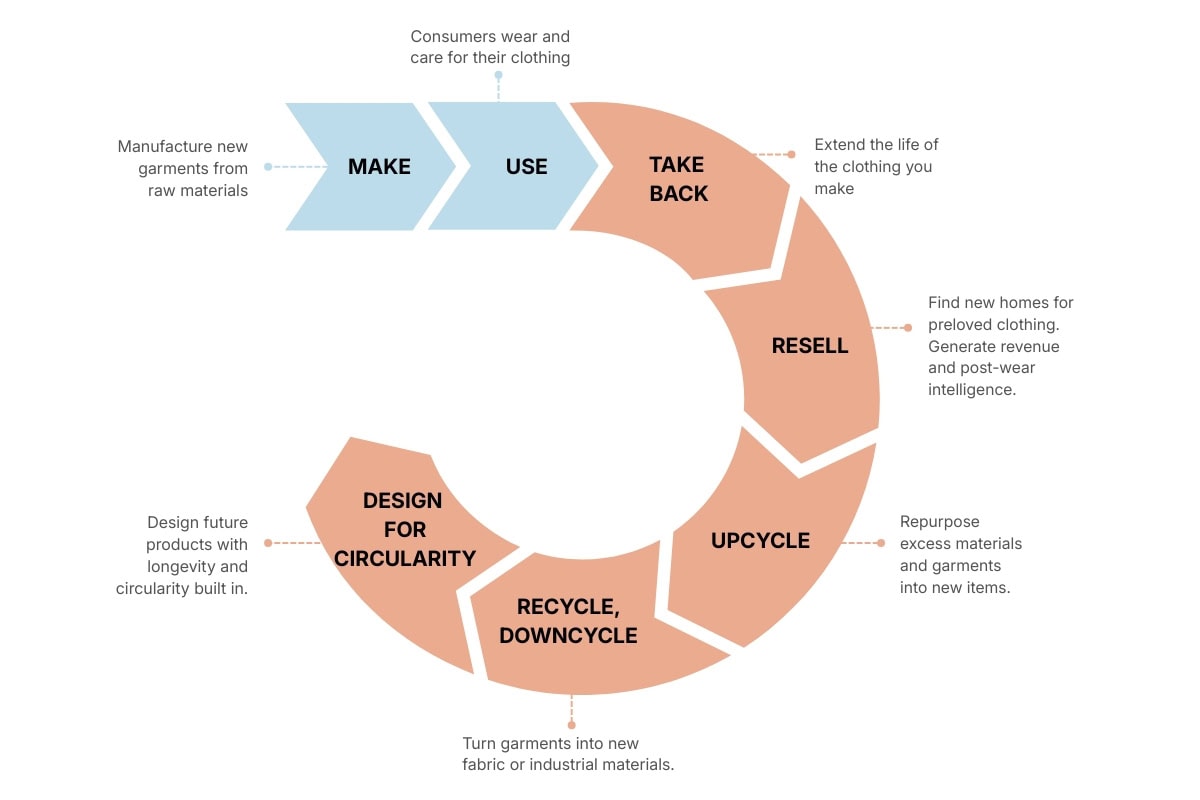
Tap each segment to learn more
Ready To Move From Commitment To Programme?
If sustainability shapes how your brand operates, we are happy to work out a take-back programme for you.
Programmes that involve community may qualify for grant support.
Our Blog
Latest Ideas and Insights That Reshape Fashion from the Neighbourhood and Around the World

The Short, Medium, and Long Loops of Circular Fashion
A clear guide to circular fashion in Singapore, what it means, how it differs from sustainability and ESG, and the three pathways to start the…
Funding Creative Textile and Upcycling Community Projects: Lessons from Past SG Eco Grant Awardees
Learn how Singapore’s fashion brands, textile artists and social agencies are using the SG Eco Fund to scale upcycling workshops and community initiatives.
Eileen Fisher’s Renew Programme: a Working Blueprint for Circular Fashion
See how Eileen Fisher’s Renew programme took back 3 million garment, turned them into a profitable circular system, and what it teaches sustainable fashion brands.